

The Total and Complete Destruction of Customer Service
Part of the "enshittification of everything"

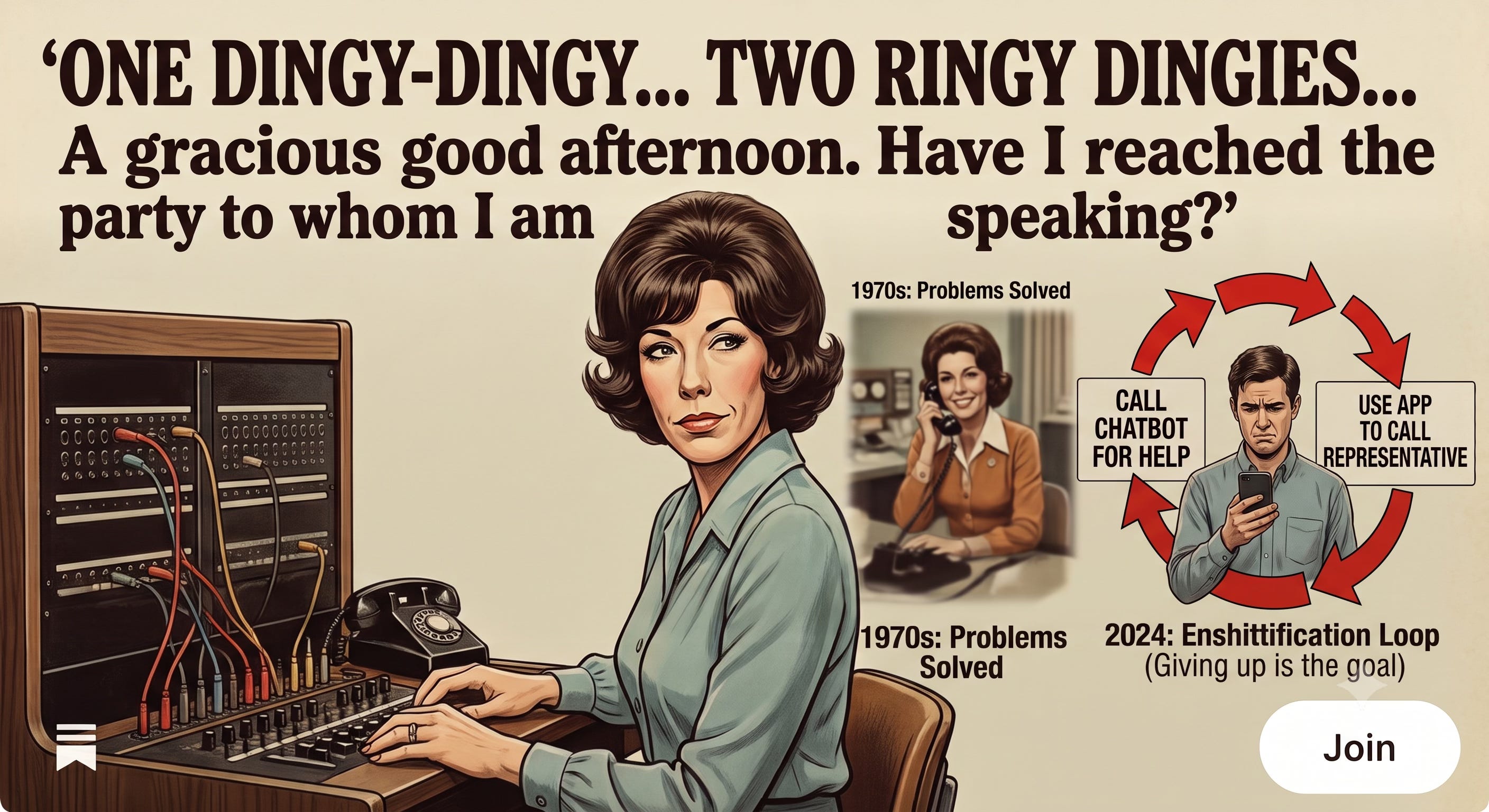
“One dingy-dingy…two ringy dingoes… A gracious good afternoon. Have I reached the party to whom I am speaking? “ Ernestine, the famous Lily Tomlin character from Rowan & Martin’s Laugh-in.
I just finished reading a pretty insightful Substack post by Dr. Robert Yoho on the “enshittification of everything.” It came at just the right time. I’ve given a lot of thought to the things he discussed. He didn’t discussed one of the underlying systems that built the foundations of good companies. But this piece builds the background of one of the rugs that was pulled out from under us - the customer - in the name of improved efficiency and profit that he does discuss. I had been thinking about writing something on the total and complete destruction of customer service for an about a month. Things came to a head this week, so here I am.
This is something I think about frequently, usually when I am trapped somewhere in the hellish selection process of an automated phone system, desperately trying to find the combination of numbers or words that will allow me to speak to an actual human being.
I am old enough to remember when customer service involved customers. And real people. And service.
In college, I had a part-time job in the missed-paper customer service department of the Lexington Herald-Leader. I would go to work at something like 4:30 or 5:00 am and answer calls, most frequently from grumpy little old ladies and gentlemen who had gotten up and discovered that their newspaper wasn’t there. The paper was an important part of their morning ritual and they expected it to be there before dawn.
I was trained to be gracious to them. I would listen, apologize, get their information and then call the person on our team who was driving around delivering replacement papers. The objective was remarkably straightforward: the customer had a problem, and our job was to solve it.
After college, I went out into big business. At Arthur Andersen, I had clients of all kinds, and many of them had their own customer service departments. These were departments full of actual people answering telephones, answering questions and solving problems for customers. That was commonplace.
Later, I ran a company called Buyer’s Access, a purchasing aggregation group for companies in the apartment industry. We operated a call center as part of the service we provided to members of the buying group. We had a team of people whom we trained to be responsive to customers because we wanted those customers to be happy and stay with us. Nearly half the team had at least 50% of their job answering customer calls.
At the time, call centers were a big business. In the U.S. in 1997, there were roughly 60,000 call centers employing more than 3 million agents. There was an enormous one near C-470 in the Meridian area by Centennial Airport in Colorado near where I lived. It wasn’t just for complaints either. In 1996, approximately, $157 billion in sales of goods and services were generated through toll-free calls.
The Bureau of Labor Statistics now estimates roughly 332,000-355,000 U.S. employees in telemarketing and contact calls centers in 2024.
Companies outsourced their customer service to operations like the one near my house in Colorado rather than staffing their own departments. Looking back, perhaps that was one of the first steps down the road we are on now. The customer service still existed. There were still human beings answering the phone. But the relationship between the company and its customers had begun to be outsourced to somebody else.
Then came the automated phone systems and the outsourcing of call centers overseas where the labor was a fraction of the cost.
Step one, automate as much as possible in a phone tree.
At first, they weren’t terrible. You would call and hear six options. If none of those six described your problem, eventually you could press zero, say “representative,” or otherwise work your way to a human being. Over time that person increasingly no longer lived in the U.S.
The machine was an obstacle, but there was still a person at the end of it, even if it was sometimes more challenging to understand them. In 2025 contact-center/business process sector in the Philippines employed about 1.68 million people.
For many years, United Airlines was an example of how well customer service could work. I have flown United for decades (1,285,186 miles the hard way), and because I flew so much in my corporate jobs, I had a special Premier customer service number. If I needed to change a flight or had a problem, I called the number. I rarely waited more than a couple of minutes. The person who answered was almost always polite, knowledgeable and capable of solving the problem quickly.
It was wonderful customer service.
Over the last several weeks, I have had a series of experiences that have made me realize just how completely we have dismantled that world and shown contempt for the customer. There are two United experiences in the trail but let’s start with the first insult that got me thinking about writing this post.
The first involved StubHub.
My daughter had purchased tickets for all of us to attend a concert. It was her birthday, and we were going to have birthday dinner and cake and then go to the concert together.
The tickets never arrived.
About four hours before the concert, she started calling StubHub. StubHub has a guarantee: if there is a problem with your tickets, they will either find replacement tickets or refund your money.
Consider the nature of a customer calling StubHub four hours before a concert. This is not someone casually inquiring about store hours. This is someone who has probably spent a significant amount of money, has made plans involving other people, may have traveled, and has just discovered that the tickets she purchased do not exist.
In other words, the customer is already highly distressed.
For something like three hours leading up to the time we needed to leave, my daughter was on and off the phone with StubHub. I heard at least three of the calls and there were several before the ones I overheard.
She spoke with three different customer service representatives. All were clearly working from outside the United States, and each had an accent so strong enough that they were difficult to understand and she had to ask them multiple times to repeat themselves. I don’t say that as a criticism of the individuals. They were doing the jobs they had been hired to do. But communication matters enormously when your entire job consists of communicating with a distressed customer. The difficulty understanding one another simply escalated a situation that was already stressful. It was distressing me just trying to listen and understand myself.
This went on and on and on.
Ultimately, StubHub did not provide the replacement tickets. We knew tickets were still available because we could see them for sale online. They didn’t live up to their guarantee. We finally purchased another set ourselves so that we could go to the concert.
I believe my daughter eventually received her refund.
Does that sound like “customer service.” Hours on the telephone on her birthday, immediately before an event, trying to persuade the company that sold her tickets to fulfill the guarantee it advertises, and ultimately having to solve the problem herself.
Then came United.
Two weeks ago, I was at the Denver airport and my United flight kept getting delayed. I decided I did not want to keep sitting there and ultimately arrive at 2 am. Years ago, there was a little section in the airport staffed by two or three agents who dealt with problem flights. If something went wrong, you went over and talked to a person. Yep, a real person.
There are still some actual people inside the airport who can help with these things, but they are behind the doors of the United Club, available to the customers paying for access. I am no longer a United Club member. I do have “one day passes” which are offered at my status level but generally I find a sign at the front of United Clubs now that says, “We are full today, no one day passes”.
So I called my Premier number.
First, the system tried to send me back to the app.
I had already tried the app. The United app seems to get redesigned every few months, and from my perspective it becomes less useful every time. What I needed to know was fairly simple. Could I change my flight? Could I get my bag back? If I couldn’t get my bag back and flew the next day, what would happen to it?
I stayed on hold while I got on the airport train and headed all the way back out past security to the front of the airport in search of a human being.
There were a couple of United pilots on the train. They could see that I was on hold with United, and we ended up having a conversation about the fact that there seem to be almost no real people left to provide customer service.
Eventually I made my way outside and found one person who could handle my situation.
She switched my flight to the next day and said the bag would follow me or I could go downstairs and have them retrieve my bag. I decided to leave the bag rather than wait another hour (or longer) to retrieve the bag.
She was lovely. That’s an important distinction. In many of these experiences, the people are not the problem. When you finally reach an actual person, that person is often wonderful.
The problem is that the system has been designed to keep you from reaching a person at all.
Then came Salt Lake City.
My son and I were there for a meeting, and he booked us a room at a Hampton Inn directly across from the meeting location. I am a Hilton Honors member and have stayed in enough Hampton Inns and Hilton Garden Inns over the years to be pretty familiar with what to expect. I’ve always been happy with the service staff at the hotels.
We checked in, went to the room, went out for dinner, came back and watched something on television. When it was time to go to bed, we went to close the shades.
There were no functioning shades.
There was, however, a glaring streetlight shining directly into our room.
We called downstairs and asked whether we could move to another room. They were sold out.
The solution offered to us was to come downstairs and get a blanket to hang over the window.
So we did.
We went downstairs, got the blanket and returned to the room. Of course, the only chairs available for us to stand on had wheels. So there we were, standing on unstable rolling chairs, attempting to tuck a blanket behind the broken shade so we could make the room dark enough to sleep.
We more or less succeeded.
The next morning, we went downstairs and the woman working there was very nice. She gave us another room. Her keyboard had a bunch of sticky notes with room numbers of rooms without blinds. It was a known issue that wasn’t disclosed at check-in. We moved our bags and went to our meeting.
We were gone all day. We came back, went to dinner and returned to the hotel. We were getting ready for bed when my son suddenly jumped backward.
“Oh, hell no.”
“What?”
“What is that bug?”
He took a picture of it.
There was a bedbug on the headboard.
That triggered a full inspection. We both got out our phones, turned on the flashlights and started looking closely at the headboard.
We found seven or eight bedbugs.
You’ve got to be kidding me.
We got dressed, packed up all of our belongings and called downstairs. The woman at the desk apparently called the manager. When we got downstairs, she initially told us that because we hadn’t booked through Hilton, we would have to go through whoever we had booked through.
Except we had booked directly through Hilton.
She checked.
“Oh, I’m sorry.”
Then we were told we could go online to Hilton customer service and use the chat.
At this point, in my view, the hotel should simply have credited our entire stay. We had spent one night hanging a blanket over a window and the next night discovering a colony of bedbugs on our headboard. There wasn’t a great deal left to discuss.
Instead, we went upstairs to yet another room and my son got on his computer.
I was trying to go to sleep and all I could hear was clickety-click, clickety-click, clickety-click.
“Are you writing a novel over there?”
No. He was chatting with Hilton customer service.
Back and forth. Back and forth. Back and forth.
Eventually, the chat told him that for faster service he should call a telephone number.
So he called the telephone number.
He was placed on hold, where he was treated to the irritating sales pitches companies now play while you are trapped waiting for help, accompanied by the sort of hold music that will absolutely drive you insane. I sometimes wonder if these systems were designed by the torture training people from the CIA.
And while he waited, the telephone system kept telling him that for faster service he should use the online chat.
Think about that.
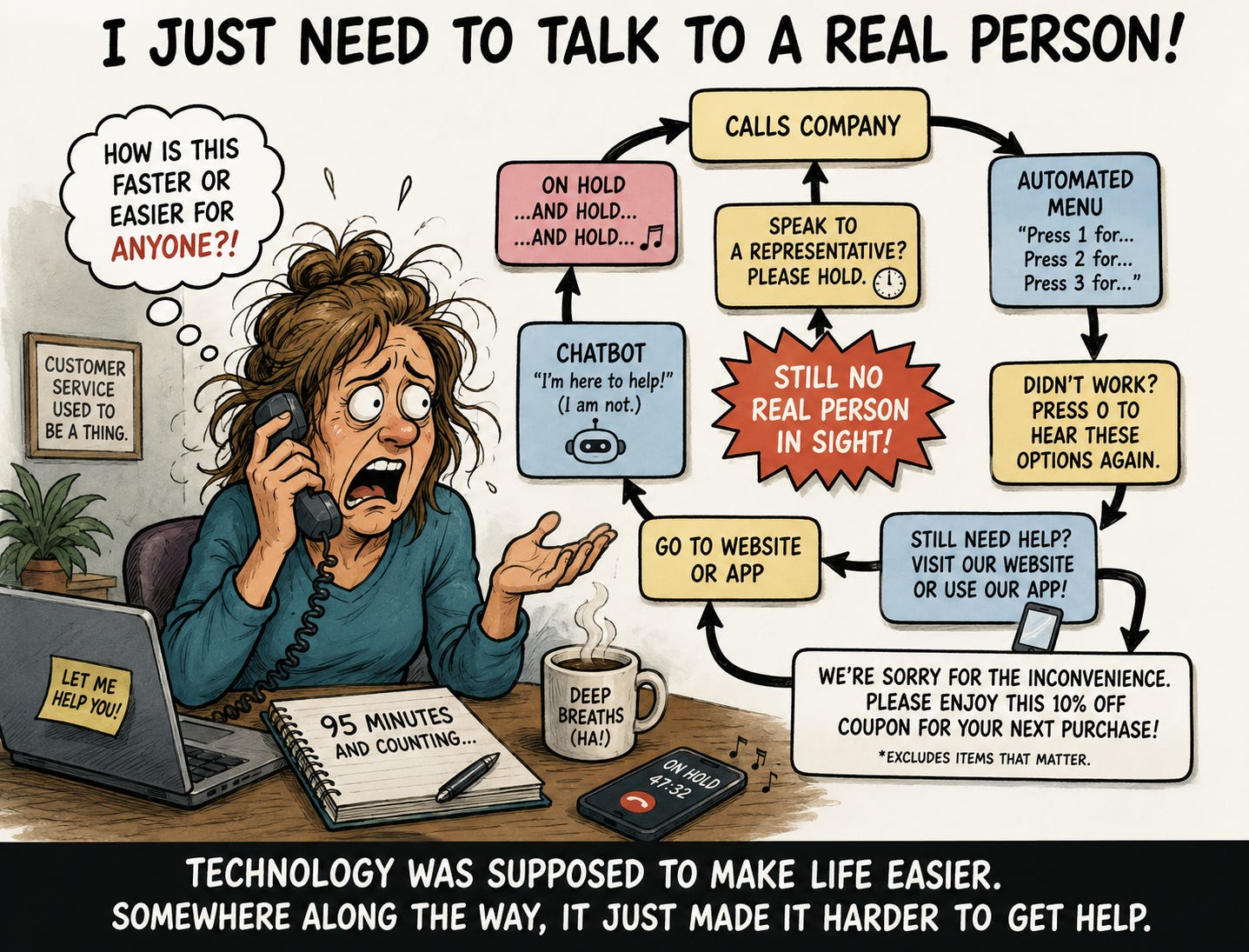
The online chat tells you to call because the phone is faster. This is also what happens when you call United - go to the App for faster service.
The phone tells you to use the online chat because the chat is faster.
Neither is fast.
It is a perpetual loop of customer-service hell.
finally spoke to the manager when we checked out the next morning. He apologized and said he had “treated that room for bedbugs”. I was thinking to myself, why on earth didn’t you toss out the fabric headboard? But I didn’t say it.
Then I got back to Colorado and had one more United flight scheduled the following day, back home to Kentucky.
The flight wasn’t until around five in the afternoon, and I decided I really didn’t want to wait around all day. I checked to see whether I could get an earlier flight on the App. I was inside my 24 flight window and it wouldn’t let me “change flight”.
There were no earlier flights to the city on my ticket, but there was an earlier flight to another airport that also worked for me. This you CANNOT do in the app but a customer service agent can easily do for you.
It also would not let me cancel the existing flight because I was inside some 24-hour window, which I still don’t understand. No “cancel flight” button on the recently updated app.
So I called my United Premier number.
The estimated wait to speak to a customer service representative was 90 minutes.
Ninety minutes. Are you kidding me?
I hung up.
I went back into the app, changed my existing flight to a date two months in the future so that I can deal with it some other time, when I happen to be standing in an airport where I can find a person, and then I purchased an entirely new ticket to the other city and a higher price (part of their game)/.
I solved the problem myself (for a price).
But a problem that once would have taken less than ten minutes with a competent United representative now required me to buy another ticket and park the old one two months into the future because speaking to a human being required a 90-minute wait. And it still took me more than 30 minutes to do it.
How is that progress?
And this isn’t limited to airlines, hotels and ticket companies.
One thing I will give Apple is that they still have the Genius Bar. There is a physical place where you can walk in and, eventually, sit across from another human being who will try to help you. But it is an odd sort of queue setup too. And I had some very unpleasant issues at Apple Stores during Covid being made to stand behind a specific line of tape and on dots keeping me six feet apart (but that’s another story).
But try finding a telephone number that gets you to a real person at many of the giant technology companies that now mediate enormous portions of our lives. You will either not be able to find one, or get stuck in a perpetual automated loop.
I have experienced what happens when this moves beyond personal inconvenience and into someone’s livelihood.
One of my company’s products was once taken down from Amazon. I spent almost 40 days trying to reach a human being who could resolve the issue. It was my best selling product and had a lot of momentum.
Forty days.
I was caught in a perpetual automated customer-service loop. The system could recognize that there was a problem. It could send automated responses about the problem. Ai was “resolving it” except that it never did and then I would have to start over. What it seemingly could not do was connect me with a person who had the authority and common sense to look at the facts and fix it.
My business lost nearly $150,000 because I could not get outside that loop. We have yet to recover our sales momentum two years hence. Disrupt their sales algorithm and good luck getting back up. I would say it has probably cost us at least $1 million.
Then there is Facebook.
After my husband’s death, my son, who also managed our business Ads account, posted information about the funeral and memorial services that we were planning in the future. He included a Google Sheet (competitor) to gather people’s email addresses so that we could send them the details for a memorial service when we had them in a few months.
Facebook locked him out. He spent more than a year, trying to get reinstated to the business account and to get his own account reactivated.
He came frighteningly close to being permanently locked out, and despite the fact that this was a business account, we could not get a human being to look at what had actually happened. He has never been able to work inside my business account again.
Then Google.
One of our products was incorrectly flagged as a pharmaceutical and therefore couldn’t be listed in Google’s marketplace. This can have a significant impact on sales.
Once again, we could not get to a real person who could simply look at the product, understand that it wasn’t a pharmaceutical and correct the error.
This is where I think something more important has happened than simply “bad customer service.” And it goes to the foundations of what Robert Yoho was talking about in his piece.
We have systematically “optimized profit” and “outsourced” for better margins and removed human judgment from the point at which the customer encounters the company.
First we had customer service departments staffed by people who worked for the company. Then we outsourced the people to bigger companies one step removed.
Then we put automated menus between the people and the customers, to reduce the number of agents required to “service” the customer.
Then we moved customer service overseas to reduce the labor costs.
Then we move things into apps and websites. Then we added automated chatbots and AI’s and avatars of the “real people” behind the company.
At each stage, another layer appeared between the person with the problem and the person capable of solving it or a real person who truly cared whether the customer stays a customer or not.
And now, in some of the largest and most powerful companies in America, it sometimes seems that there is no person at the other end at all.
The customer is expected to navigate the system until the customer either finds the answer the company has already decided to provide or just gives up in exhaustion and frustration.
That last part is important.
I have begun to wonder whether giving up isn’t a failure of these systems at all. Rather it is the point. Perhaps it is part of the planned and modeled economics.
Every human customer service representative costs money. Every refund costs money. Every disputed charge, incorrectly suspended account, lost ticket, defective product or mistaken algorithmic decision that a customer eventually stops fighting costs the company less and drops more money to the bottom line.
The burden has been transferred from the company to the customer.
You wait.
You click.
You repeat your information.
You explain the problem again.
You upload the document.
You receive the automated response.
You appeal.
You wait.
You try the chat.
The chat tells you to call.
You call.
The recording tells you to use the chat.
Eventually, maybe, you give up.
And somewhere on a corporate spreadsheet, that probably looks like efficiency. Someone gets a bonus for that increase in profit and looks at some spreadsheet that doesn’t show anywhere that a customer was ever unhappy.
I don't have a good solution yet. Leaving some of these major infrastructure companies would be extremely difficult in the world we live in but maybe that is ultimately the answer. If enough people say NO.
But I do know that we shouldn’t confuse what has happened with technological progress.
Technology should make it easier for a company to serve its customers. If I can solve a simple problem in an app in thirty seconds, wonderful. I don’t need a human being for every transaction, but I do like real people.
When the technology cannot solve the problem, there has to be a door. And it has to be easy to access….. a real person, one you can understand easily and who has the authority to listen, think and act.
There has to be a way out of the machine. Increasingly, there isn’t.
Perhaps that is why dealing with a small company where somebody still answers the telephone—or actually calls you back—can feel almost startling now. I call customers back myself on occasion and especially those who are dissatisfied. I want to know why and what I can change or understand to make things better.
That used to be called customer service.
Maybe we should start demanding it again. But the question is HOW? How do you demand something from a machine?
I’d read his post earlier … thanks for reminding me of him … and I dragged the book back to the top of my Kindle app to read some more. This is a great post!
Just a note, back in 1975-1985, I was the “Shell Answer Man” for the Midwest Customer Service. We had phones … well, that’s all there was, and mail. My biggest deal was around Self-Service, when that started. Suddenly, many calls of upset people “You forgot to put my gascap back on” …. Rather than argue, I got Houston to allow an automatic $25 credit, and told them to go buy a new one, no receipts needed. So I align to this …
I agree with you about all of this. I also couldn't help but notice that your customers also have to use Amazon to get your product. This puts them into the same wrestling match you are in when they have a problem. We need to disrupt the entire sales pipeline. Go back to (or keep supporting) in person stores.
Our credit union told us we had to start using Zelle to transfer money to our adult kids accounts *in the same credit union.* Um, no. I called a local branch and talked for an hour with a wonderful person with the appropriate name of Jesus. I opened a shared account with one of my kids and can just transfer into that one. And for the other one, we send him a check using the bill pay option. Both options make the credit card company have to work harder than it did before they required Zelle (a conglomerate of seven banks). I love that for them.