
When the Chairs Disappear
Financial Abstraction, Small Business, and the Quiet Erosion of Life Expectancy

The Quiet Erosion: How Over-Abstraction Shortens Lives and What We Can Do
I’ve spent my career in auditing, corporate business, and now running a small business—experiences that have shown me how economic systems really work, especially during crises. I started college amid the 1979–80 collapse (interest rates over 20%, my father’s bankruptcy), entered the workforce as oil crashed in Texas, and later watched the savings-and-loan debacle. Each time, insiders benefited while others paid the price.
Financial collapse rarely arrives as a dramatic crash like the run on George Bailey’s Building and Loan. More often, it’s gradual: the music plays softer each year, chairs vanish slowly. Rules shift, access tightens, promises get reframed. People feel the ground slipping long before they can name it—like musical chairs in kindergarten, early training for real-life games where, at the end, only one chair remains for the insiders.
Since 2008—and more intensely since 2020—we’ve endured not a single crisis but prolonged institutional stress. Markets function, tech advances, GDP ticks up, yet fundamentals erode: social trust, faith in long-term promises, and, crucially, life expectancy.
What “Abstraction” Really Means
Abstraction isn’t abstract theory; it’s practical substitution: a mortgage for a home, a pension for future productivity, a 401(k) for stable markets and rules. Derivatives abstract actual assets. Abstraction enables modern economies, but problems arise when claims multiply faster than underlying reality supports them—e.g., paper silver contracts vastly outnumber physical supply amid soaring demand for EVs and data centers. Trust keeps the system running; when it weakens, adaptations favor insiders, quietly removing chairs for everyone else.
2008 as the Moral Break
2008 wasn’t just financial; it shattered the belief that playing by the rules protects you. Policy stabilized markets but prioritized big banks and abstractions over ordinary lives. The damage appeared subtly: delayed families, institutional distrust, dimmer futures for our children. U.S. life expectancy peaked around 2014 at about 78.9 years, then declined—unusual in wealthy societies without major structural failure. COVID accelerated, not started, the trend.
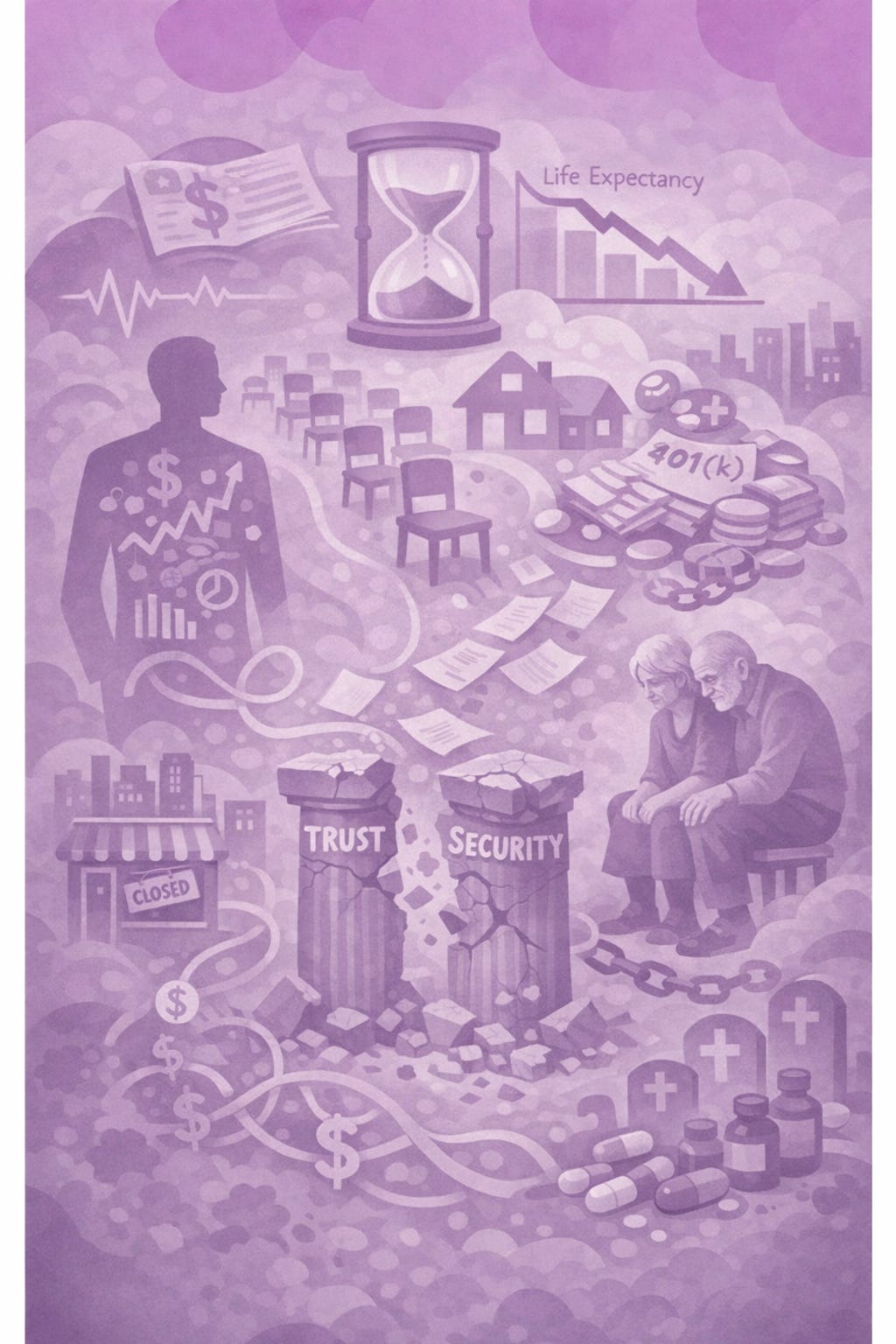
: Abstraction Hits Home
Retirement systems reveal abstraction’s personal toll. We shifted from defined-benefit pensions (unsustainable due to longer lifespans) to defined-contribution 401(k)s, transferring risk to individuals. These depend on liquid markets, stable rules, and reliable custodians—fragile assumptions. Recent pushes to allow private equity in 401(k)s (backed by the August 2025 executive order on democratizing access to alternatives) are framed as opportunity. In reality, it’s a dumping ground for private equity’s liquidity problems: as IPOs and refinancing dry up, they offload illiquid, model-valued assets into retirement accounts that delay price discovery and accountability. Risk doesn’t vanish—it gets pushed onto savers who can’t easily exit. This deepens abstraction when trust is already low, quietly removing more chairs. If your 401(k) includes or plans to include private equity, run—opt out if possible, or demand your fund managers exclude it to avoid bearing the dumped risks.
When Systems Can’t Pay, They Adjust—Quietly
History shows systems rarely admit overload. They dilute benefits, extend timelines, complicate access. One consistent outcome: life expectancy falls. Chronic uncertainty imposes allostatic load—disrupting heart, immune, and metabolic function, accelerating aging. Loss of future orientation is especially toxic; when effort no longer compounds, biology prioritizes endurance over longevity.
Russia post-Soviet collapse saw male life expectancy drop 6–7 years in a decade—not from famine or war, but institutional breakdown. In the U.S., it’s slower: rising “deaths of despair” (suicides, opioids, alcohol, heart disease) since 2008, accelerating post-2020. These aren’t moral failings; they’re responses to eroded agency.
Small Businesses: The Lost Stabilizers and Bastions of Freedom
Small businesses aren’t just economic; they’re cultural anchors—offering identity, mentorship, local credit, and unmediated human connection. More crucially, profitable small business owners represent a rare form of freedom in modern society: they operate largely outside algorithmic control, independent of wage labor, platform metrics, or opaque scores. They hold cash-like assets, make local decisions quickly and humanely, and can say “no” to extractive systems. This economic, psychological, and temporal freedom stabilizes culture but makes them vulnerable.
From 2020–2025, they faced asymmetric shocks: sudden shutdowns, scale-biased rules, tightened capital. Many closed permanently, while giants profited. The loss ripples: communities lose rooted decision-makers, impersonal credit rises, dignity erodes. Stress compounds, horizons shorten, bodies pay—another chair gone.
Shorter Lives: When Institutions Fail, Biology Pays the Price
When retirement feels unreachable, small businesses vanish, and institutions extract rather than support, people stop planning long futures. The body follows suit. Chronic stress from lost agency and predictability accelerates aging via allostatic load—disrupting heart, immune, and metabolic systems. Reduced longevity quietly eases future claims on overburdened systems (whether by design or not, the effect is real), leaving fewer players in the musical chairs game. U.S. life expectancy peaked around 2014 at about 78.9 years and has not fully recovered—dipping sharply post-2014 and during COVID, rebounding modestly to around 78.4 years by 2023 with provisional data suggesting continued slow gains in 2024–2025, but still reflecting ongoing structural erosion. This is the clearest biological report card on institutional health.
Rebuilding What Works
Health returns through predictability, dignity, and agency—not more abstraction. Key actions:
Patient, local capital — Community banks that value cash flow and character over algorithms; financing that grows with businesses, not forces scale.
Rule stability — Predictable policies so small firms can plan without midstream volatility.
Treat small ownership as public health infrastructure — Policies favoring consolidation erode resilience; reverse that to restore agency and reduce stress.
Protect cash and fungibility — Cash means optionality and insulation from control; don’t let digital displace it.
Value skills over credentials — Transferable abilities anchor people locally, shorten chains.
Cultural permission for “enough” — Durable, local enterprises aren’t failures if they stay small—they’re often the highest-value outcome.
Progress redefines: more agency, circulating capital, believable promises, coherent institutions. These lengthen lives historically.
Abstraction stabilizes markets; only human-scale coherence sustains people. Rebuilding starts locally, in small businesses and relationships that work. Seeing this isn’t pessimism—it’s the realism needed to change course.
Leon DA et al., BMJ (1997)
Shkolnikov VM et al., Population Studies (1998)
Stuckler D et al., The Lancet (2009)
Case A & Deaton A., PNAS (2015)
When I decided to go to college at age 42 (in Alabama with seven bairns still at home), one of the first classes I took was Sociology 101. I was astonished to read that across the globe, no matter what country, suicides were reliably pegged to a country’s economy! When hopes for a secure economic future rose, suicides declined. When the economy flagged or tanked, suicides rose, belying the wide held belief that suicides were a result of personal choices and circumstances that were unique to that persons life.