

Wildfires in the West
What’s Actually In the Smoke

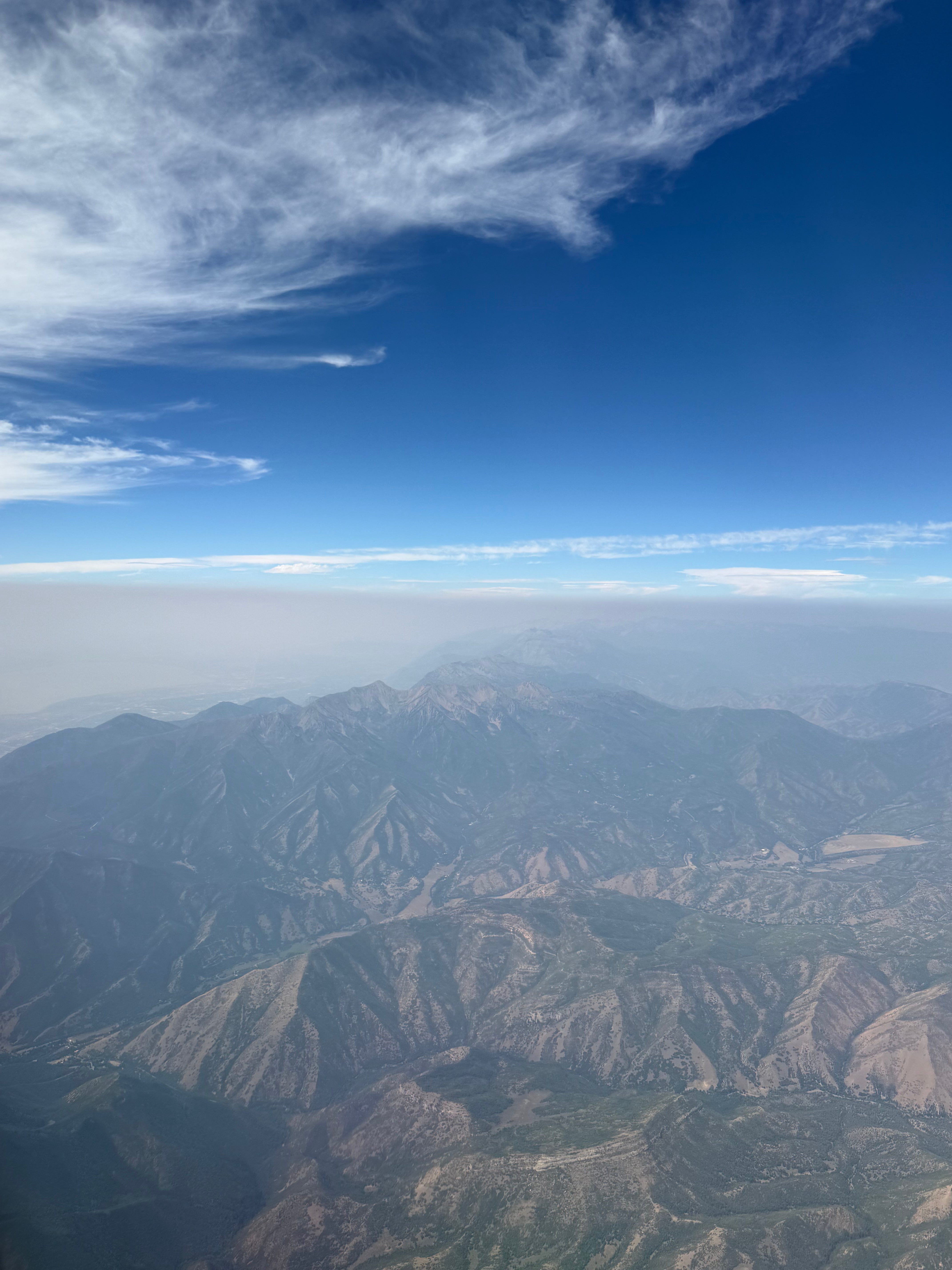
I landed in Salt Lake City this week and the sky was a dirty gray film of smoke. The Utah Department of Environmental Quality has the Wasatch Front sitting in “unhealthy for sensitive groups” territory, and it’s not one fire — it’s smoke pulling in from multiple fires burning across Utah, Nevada, and the broader West. I checked in with friends in Spokane on Monday. Same story there: the Old Trails Fire and others have put Spokane on the list of the worst air quality in the country right now. I started following the fires there and just received notice of another evacuation order in Spokane.
Wildfire smoke seasons have become a fixture of Western summers. They make interesting and sometimes beautiful sunsets but the particulates in the air a not good at all for your health. And who wants to hike a 14er in Colorado when you are sucking in smoke at altitude? What’s different in my thinking about fires this year is a question I hadn’t thought to ask until one of my customers posted about it in Dr. William Davis’s Infinite Health Facebook group: how much of what we’re breathing didn’t come from the trees themselves, but from what’s been sprayed on them.
Glyphosate is a routine part of forest management
This was shocking to me when I first heard it. The U.S. Forest Service and private timber companies spray glyphosate — the active ingredient in Roundup — on cleared and burned forest land, usually a few years after logging or after a fire, to kill the broadleaf and shrub species that compete with the conifer seedlings companies want to grow for timber. Congressional letters this year, following a year-long Mother Jones investigation, pressed the Forest Service for answers about large-scale spraying near trails, campgrounds, and waterways in fire-affected California forests. Only California and Arizona require public reporting of the practice, so nobody has a full national picture of where or how much is used. Read the Mother Jone’s article for more background.
Here’s the part that’s directly relevant to fire risk, and it’s well documented by forest ecologists: glyphosate kills off deciduous species like aspen and birch, which hold moisture and burn slowly, while leaving conifers — which are more flammable — as the dominant species. Environmental groups and wildland fire ecologists in both the U.S. and Canada have been raising this for years. Killing the fire-resistant underbrush to protect a commercial conifer crop can leave a forest primed to burn faster and hotter the next time. I read an article years ago about how our forest management methods set things up for much larger fires. I’m not sure how long the herbicide has been involved.
What’s genuinely unknown
I didn’t find any published reach on this question: does glyphosate sprayed on a forest that later burns end up in the smoke itself? When glyphosate combusts, it can break down into other compounds, including its known metabolite AMPA and various amine and phosphorus-containing byproducts. But wildfires also create massive plumes of rising hot air that can carry unburned organic material, ash, and particulate matter high into the atmosphere. Whether those compounds are present in wildfire smoke plumes at levels that matter for human health is, as of now, an open question. No state or federal agency has systematically measured glyphosate or its breakdown products in wildfire smoke, and no one has done biomonitoring on firefighters or downwind communities to check. That’s a real gap.
As you know, I’ve written quite a bit about glyphosate and its widespread environmental impact. What I can say with more confidence, is the separate and better-established piece: glyphosate disrupts the shikimate pathway, the route by which gut bacteria — including Bifidobacteria — produce aromatic amino acids that feed into everything from neurotransmitter synthesis to the gut’s protective glycocalyx layer. That mechanism doesn’t depend on smoke exposure but delivery through smoke and air particles is a potential vector throughout the system. The wildfire smoke question adds a second, unproven route of exposure to a chemical we already have reasons to take seriously.
How can I protect myself from the smoke
Regardless of what’s eventually confirmed about glyphosate combustion products, the particulate matter in wildfire smoke — the PM2.5 that shows up on every air quality index — is a known, well-established hazard on its own. It’s small enough to get past your nose and throat and into your bloodstream, and it’s linked to heart attack and stroke risk, not just lung irritation.
Health problems related to fire, smoke and temperature inversions that hold the particulate matter close to the ground have been around for a long time. Read about The Great Smog of London in 1952 and the temperature inversion that trapped smoke and sulfur dioxide sickening over 100,000 Londoners.
Two different problems need two different filtration approaches, and it’s important to know what you are looking for before you buy anything. A HEPA filter captures particles — smoke, dust, pollen, soot — by trapping them as air passes through a dense mesh. It does essentially nothing for gases and volatile organic compounds, because those pass straight through as vapor. If glyphosate combustion byproducts ever are confirmed in smoke, some of them would likely behave as gas-phase compounds, which means a purifier needs activated carbon, not just HEPA, to have any chance of addressing them. But there are proven VOC’s you need to be concerned about in wildfire smoke beyond our glyphosate speculation.
Common VOCs in Smoke
Benzene: A known carcinogen linked to leukemia; often found in high levels during active burning.
Formaldehyde: An aldehyde that irritates eyes, nose, and lungs, and forms when smoke interacts with UV light.
Acrolein: A strong respiratory irritant produced by the burning of plant matter and fats.
Toluene and Xylenes: Part of the BTEX group originating from heated and burning organic material.
Polycyclic Aromatic Hydrocarbons (PAHs): Semi-volatile and heavy organic compounds linked to heart and lung disease.
This is why I like the AirDoctor units when smoke rolls in (use Wildfire10 discount code for 10% off special they are running). I met the founder of the company earlier this year, Helen Christoni, and was really impressed by the company’s products. They pair a HEPA-type filter — AirDoctor’s UltraHEPA, tested to capture particles down to 0.003 microns, well below the standard HEPA threshold — with a separate carbon/VOC filter designed to adsorb gases and odors rather than just particulates. You’re covering both known exposure routes: the particulate matter that’s already proven harmful, and the gas-phase chemistry that smoke can carry, whatever turns out to be in it.
If you’re in Salt Lake City, Spokane, Denver or anywhere else under a smoke advisory this week, that’s the practical takeaway. Check your air quality index. Keep windows closed. Run filtration that actually addresses gases, not just particles. And keep an eye on this glyphosate-in-smoke question, I will too.
Thank you for speaking out about the problems with glyphosate. In CA, a coalition is forming to fight the spraying of our forests. There is a website nopoisoncalifornia.org that the coalition has started.
We had the Canadian smoke this year and last. It’s not just smoke … those hazards you mentioned, plus other contaminants it picks up along the way, all heated by the Sun. Toxic cocktail. We have 4 high end HEPA/Carbon filters. No smoke smell or contaminants.