
A Beautiful Dynamic Equilibrium
What if health is really resilience, the ability to withstand shifts and bounce back?

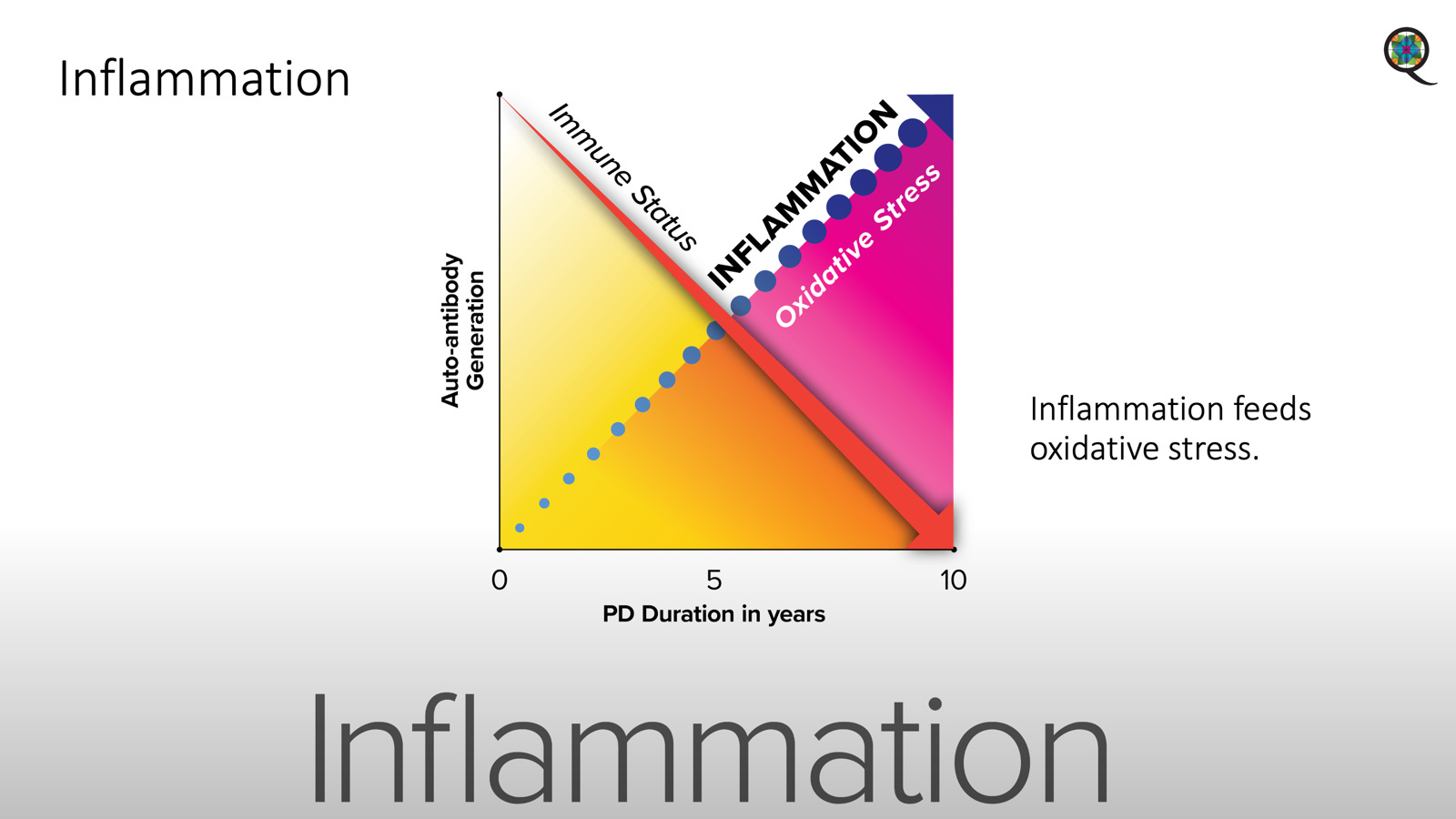
This week I had the opportunity to hear two different people that I follow talk about something that converged with my thinking on what was happening to my husband John, looking back on it now, after he passed away.
The first was a presentation by Dr. Laurie Mischley, who has been working with Parkinson’s patients for at least as long as I have been searching for answers. She has some great results with her patients and gives people hope through the results and the research that she does. Many of her patients actually improve which is something you are told never happens when you first get a diagnosis. She has even developed courses and an app to help people use the tools she’s built. One of the things she mentioned specifically that really resonated was the troubling fact that neurologists do not order bloodwork. So she asks her patients to do specific bloodwork that they often have to pay for out of pocket because insurance doesn’t cover it.
The other was Martin Picard, who has become popular through appearances on the Huberman Podcast and Diary of a CEO. I listened to his interview on DOAC a few days ago. Martin studies mitochondria for a living, but he often talks about the bigger picture when talking about the tiny mitochondria in our cells. He talks about energy, because that’s what mitochondria work with in our body. He talks about the organism as a whole, not just the tiny mitochondria — a system that is constantly sensing, adjusting, and reforming. He specifically says they are not a machine holding a fixed setpoint, but something closer to a beautiful, dynamic equilibrium: always moving, never static. This is what fits with Barry Ninham’s work and is why I first started following Martin. I thought he might be the kind of scientist who would immediately see the importance of Barry’s body of work. I reached out to him to set up an introduction to Barry but so far I haven’t heard back.
His research has some key ideas that I like. First, that the body is self-organizing and adaptive, not simply reactive. Much of Barry’s work covers the concept of self-assembly. Martin explains that mitochondria sense stress, signal to the rest of the cell, and participate in deciding how the organism responds to the world, rather than just supplying the energy for whatever the organism has already decided to do. He also talked about the fact that most interventions, especially the pharmaceutical kind, work by overriding some part of that system rather than supporting it — which is why he’s cautious about magic bullets, and why he tends to trust lifestyle change over supplementation when the two are in tension. Because the body has a beautiful way of maintaining homeostasis.
I find myself agreeing with most of it, though he still uses the classical concepts that Barry is teaching me to avoid. I too slip into that habit because there really aren’t good descriptions for what Barry’s work has shown so we default to the language that people are familiar with and that is the classical models of science Its a bad habit. Barry and I have been working on a paper on mitochondria with several collaborators for a while now.
But what I’ve been thinking about and pulling together — from my own knowledge, from Laurie’s biomarkers, and from what Martin talked about in the podcast this week — is this question. What actually creates that dynamic equilibrium in the first place? If health is the capacity to return to balance, where does that capacity come from, and what determines how much of it any of us has? I’m sorry to tell you that I don’t answer that question in this post but I would love to hear your thoughts.
At the same time I have been working on summarizing the stress timelines of subjects we interviewed for our Voices of Parkinson’s docuseries. That has has me wondering about peace — peace of mind, the peace that passes all understanding — and whether that isn’t a key piece of the puzzle too. Both Laurie and Martin touch on this at the very edges of their work, and I’ve written about it more deeply in my book Connected. But the person who first mentioned the word in a clinical setting, was Dr. Ben Edwards. Peace sits at the top of his own four pillar health framework. He was the first doctor who ever told John, directly, that he wasn’t at peace, and that there was a spiritual dimension to his illness that no prescription was going to reach. He needed to look inside himself and to his spiritual relationship with God.
I think the work with Barry holds the physical answers. But he also talks about “forces” and there are all kinds of forces. I think “peace” may be one of the forces missing from the equation entirely. Perhaps it is the most important one of all.
I arrived here by watching my husband for twenty-two years and interviewing people with Parkinson’s in the last two years for our docuseries.
John’s story shifted my thinking about health
John was diagnosed with Parkinson’s in 2002. At the time he looked “healthy” on the outside. I couldn’t understand how someone who looks healthy could have an old persons disease. I have since come to learn that many people who look healthy on the outside actually aren’t healthy at all.
Most people think about diseases like Parkinson’s as a trajectory of worsening symptoms, tracked by a score, managed by a medication schedule. This is what they tell you to expect when they tell you that you have Parkinson’s. It’s progressive, you have a few good years. Symptoms did worsen, in fits and starts, over two decades. But John didn’t follow that steady downward trajectory.
What I can see now, looking back is that his resilience was fading.
There was a real but slow progression over those two decades. Often the doctor would even comment about how much better John was doing than most of her other patients. He had periods where he didn’t do as well. But I also learned looking back that many of those periods where he didn’t do as well were highly correlated with stressors.
Each time he would decline, we found something that would help him spring back. In 2002 it was changing his diet. In 2008 it was the Pedaling for Parkinson’s biking program. At one point it was detoxing heavy metals. In 2015, when we were in a temporary condo, it was getting the water filtered and adding an infrared sauna. In 2017 it was Sugar Shift, and at the end of that year, treating a parasite. Another time it was mindset work to forget about a vision of decline that a woman spoke about that frightened him. Each of those brought him back, for a while. He was actively running biking programs and doing the things he loved nineteen years in to his diagnosis.
But he got COVID in December 2021, and something changed dramatically. He was very sick. We were lucky to keep him out of the hospital but his recovery was very difficult. He couldn’t seem to bounce back.
Working on his COVID recovery the thing that reliably worked, every five weeks, was a five-day Prolon fast-mimicking cycle. He was consistently at his best on day five of that protocol. But the next day when he would re-feed he would start to run out of energy. But he was much too thin after Covid to do any sort of long term fasting. The five-day Prolon fast was pushing it with his weight loss. We even timed the end of the last fasting cycle to land on our daughter’s wedding rehearsal dinner, and John did great on her wedding day, lasting all the way into the evening without crashing.
In the last year, we started tracking things we’d never had reason to track before: his body temperature, usually running about two degrees below normal, and swings between alkalosis and acidosis dramatic enough that we could tell which one he was in and try to correct it, based on how quickly he came back once we did. That’s about as literal a description of lost buffering capacity as I can give. Acid-base balance is one of the most tightly regulated systems in the body, held within an extremely narrow range precisely because so little else works properly outside the physiological balance point. Watching him swing between the two extremes, and needing our own intervention to bring him back to center, was watching the buffering system itself run out of room. I bought a book called Acid-Base, Fluids, and Electrolytes made ridiculously simple.
First of all, it’s not ridiculously simple and as I have learned from Barry there is something called specific ion effects, meaning that different electrolytes have very different impacts in the body and it is what is called a “many body” problem. Not so simple as adjusting sodium and potassium.
So John had progressed rather slowly prior to Covid. What changed after COVID was something underneath the progression: the things that used to bring him back didn’t work as well anymore.
Which is the question this whole essay is built around: what allows a body to buffer change and repair itself in the first place, and what happens when that capacity erodes?
Laurie Mischley asked a similar question
Laurie’s talk was about biomarkers of disease progression in Parkinson’s. Laurie commented at the beginning of her talk about neurologists not ordering bloodwork. I have often questioned this practice. It is a description of a structural blind spot in the standard of care. Parkinson’s is tracked almost entirely on one axis: symptoms, scored on a clinical scale, visit after visit. Whatever is happening underneath those symptoms, in the actual biochemistry, mostly goes unmeasured for years at a stretch, because it’s not the “standard of care”. Can I just say - does anyone want standard care?
Mischley’s answer to that gap was to start measuring it herself. She’s spent close to a decade running the MVP Study — Modifiable Variables in Parkinsonism — tracking more than three thousand people with Parkinson’s disease over time, looking at the everyday variables that don’t usually make it into a clinical trial: financial stress, social connection, sleep, diet, physical activity, supplement use. Her earlier CAM Care in PD research, published in 2017, had already established that diet and lifestyle factors track with how fast or slow the disease progresses. And she has found a number of things that make a difference, like eliminating dairy, staying connected and eating less red meat to name a few.
One finding in particular stands out because it’s not a question you get asked at the doctors office. People who reported being lonely had roughly 55% greater symptom severity over time, a magnitude of effect comparable to the benefit of exercising thirty minutes a day, seven days a week. Loneliness was a modifiable variable with an effect size on par with exercise. I think that fits in the context of my question about peace. When we are in relationship, not lonely, we are often (not always) more at peace because we feel like we matter to others. An important aspect of feeling peaceful is belonging, feeling that you are not alone.
The other biomarkers she tracks aren’t abstract like loneliness. In the presentation that started all this, she walked through homocysteine, omega-3 fatty acids, HDL, RDW, albumin, hair mineral levels, heart rate variability, sleep — a fairly short list, though she mentioned at the beginning she had forgotten to include the gut microbiome. Her list correlated against how her patients were actually doing over time. It’s the list most neurologists never order. But many of these tests we had done for John at one point or another. So this week I went back through some of John’s labs with this same framework in mind, I realized I’d ended up building a version of that panel for him myself, one test at a time, over almost a decade, without ever calling it that while I was doing it. I was just looking for answers as I learned new things. Often even with the information we did not really knowing what to do with it because Functional Medicine was still in its infancy. We even had hair minerals pre and post Covid. But we didn’t have HRV.
Parkinson’s doesn’t progress at the same rate in everyone. Some people decline quickly. Some stay remarkably stable for years, even a decade, on very different regimens, living very different lives. And John did well for almost 20 years. The standard framing asks why people get Parkinson’s. Mischley’s data points toward a different question: what preserves resilience once you already have it? Why do some people do better than others? What factors matter the most? How can we use this information to help more people have better outcomes?
So I took at a look at some of John’s data to see if there was something new to learn that could help other people with Parkinson’s.
John’s four-year plateau
John and I funded a project at the University of Chicago in early 2015 doing time series whole genome (expensive) sample of our microbiomes (60+ samples). Later that year I started The BioCollective and started collecting John’s and hundreds of other people’s stools for research to help accelerate the pace of research across diseases, not just Parkinson’s.
2016 was the year we spent simply collecting data on his microbiome, a full year of watching and thinking about whether or not we could do something to change it. It was fourteen years in to John’s diagnosis in the fall of 2016 and he had started walking with a cane and having trouble navigating crowds. I came up with the idea of the probiotic Sugar Shift after hearing a talk at the World Parkinson’s Congress in Portland about mannitol stopping the aggregation of the proteins connected to Parkinson’s and clearing them from the brain of a mouse. I have done hundreds of podcasts telling this story. If you want to hear the entire tail, it’s not hard to find. Around Christmas 2016, John started taking the proto-type of Sugar Shift, a synbiotic formulation aimed initially at producing mannitol in the gut, restoring a carbohydrate metabolic function. We saw a response within a couple of weeks. He no longer needed the cane. Four months later, he attended our daughters college graduation navigating the crowd of thousand with ease.
In 2016 his UPDRS score — the Unified Parkinson’s Disease Rating Scale, the standard clinical measure of motor progression — had been 35. The higher the number the more advanced the disease. It improved over the course of 2017 while we continued measuring improvements in his microbiome. His UPDR score stabilized in the 19–20 range for the next four years. That’s not a small effect on a scale where higher numbers mean more impairment; it’s roughly the difference between moderate and mild disease. The timeline wasn’t a clean, single-variable experiment: in the late fall of 2017 he was also treated with antibiotics for a parasite. And that wiped out the gains from the probiotic. But he bounced back from that too. He was really stable for four years.
Here’s what I don’t think happened: I don’t think we restored dopamine neurons. There’s no mechanism by which a microbial intervention meaningfully replaces lost dopaminergic neurons, and I’m not aware of evidence that it does. But there is dopamine made in the gut by bacteria, and there are gut bacteria that can “steal” dopamine in the gut. And I don’t think Parkinson’s is just a dopamine deficiency to begin with. I am confident of the strong connection to gut bacteria and the deeper science of the surfaces that erode in the body which is what we cover in our paper Gut, Brain and Glycocalys: A Portrait of Parkinson’s. What John taught us is that there are things that can be done to make a difference. And that is what Laurie Mischley is teaching us too!
What I think we may have restored with the Sugar Shift is part of an ecological system that had gone missing — a set of microbial relationships, metabolic byproducts, and downstream host functions that had eroded over years, well before anyone was measuring them. That restoration may have done something more general than treat a specific symptom. It may have widened his adaptive range, increased how much perturbation he could absorb before it showed up as a crisis.
This isn’t the same as saying Sugar Shift treats Parkinson’s. It’s closer to this: it may have partially restored the thing that lets a body buffer change, in a person whose particular vulnerability happened to be dopaminergic. The same restoration, in someone else, might show up as improved resilience in an entirely different system, the way it did in our clinical trial in diabetes. I think that distinction matters both for how Martin Picard talked about supplements on the DOAC podcast, and for everything that follows.
A different way to think about supplements
Martin Picard’s caution about supplements is well placed, and also incomplete.
Picard is right to be skeptical of interventions that override physiology, that force a result the body wasn’t asking for: stimulating ATP production directly, forcing nitric oxide production, suppressing inflammation broadly rather than resolving whatever is driving it, manipulating glucose directly rather than addressing why glucose regulation went sideways. These can produce a number that looks better on a lab report while doing nothing to restore the system that made the number go wrong in the first place, and sometimes they make the underlying problem harder to see. This is a point I’ve made before about the potential dangers of biohacking, when it pushes the system too far in one direction, then too far back in the other.
But I don’t think every intervention belongs in that category. There’s a second class that doesn’t push physiology in a direction. It tries to restore something that used to be there and isn’t anymore: restoring microbial ecology, restoring the nutrient cycling a healthy microbiome performs as a matter of course, rebuilding ecological relationships between host and microbe that industrial food, antibiotics, and modern hygiene have stripped away, reducing the chronic endotoxin burden that comes from a gut community stuck in the wrong configuration, adding back the raw materials that the surfaces need to rebuild themselves.
These interventions don’t force equilibrium into existence. At their best, they remove an obstacle to the equilibrium the organism was already trying to reach on its own — a fundamentally different mechanism than a magic bullet, even though from the outside, a bottle, a dose, a daily habit, the two can look identical. The real question for any intervention is whether it’s pushing the system somewhere, or gently supporting its ability to rebound. Martin Picard’s view that the body is a self-organizing, dynamic equilibrium challenges the standard medical focus on overriding physiology. My experience with Sugar Shift suggests that interventions should not aim to treat specific symptoms, but to restore missing ecological functions—widening the body’s adaptive range. By shifting focus from disease trajectories to the restoration of resilience, we can better support the body’s ability to absorb perturbation and return to center.
Buffering capacity is distributed
Buffering capacity is an emergent property of the interactions between the all of the organs and systems in the body and communication is happening across the system at the interfaces. When these systems lose coherence, the organism’s adaptive range narrows long before individual markers cross into “abnormal” territory.
Buffering capacity isn’t the health of any one of these systems. It’s the ability of all of the systems to stay coherent and return to homeostasis when disturbed. This morning I was thinking about is as the ability to move from order, to chaos and back to re-ordered adaptation. The systems of the body are doing this all the time.
I’ve mapped various aspects of this over the years, but it really came into focus while I was writing my book, especially the impact of stress and lack of peace of mind. On the physical side, I also had diagrams I used in my presentations. This one in particular stood out to me because it has the coagulation cascade right there. I didn’t focus on it from a blood coagulation perspective, in retrospect, that was a mistake. I was looking a amyloid formation in the center of the green section.
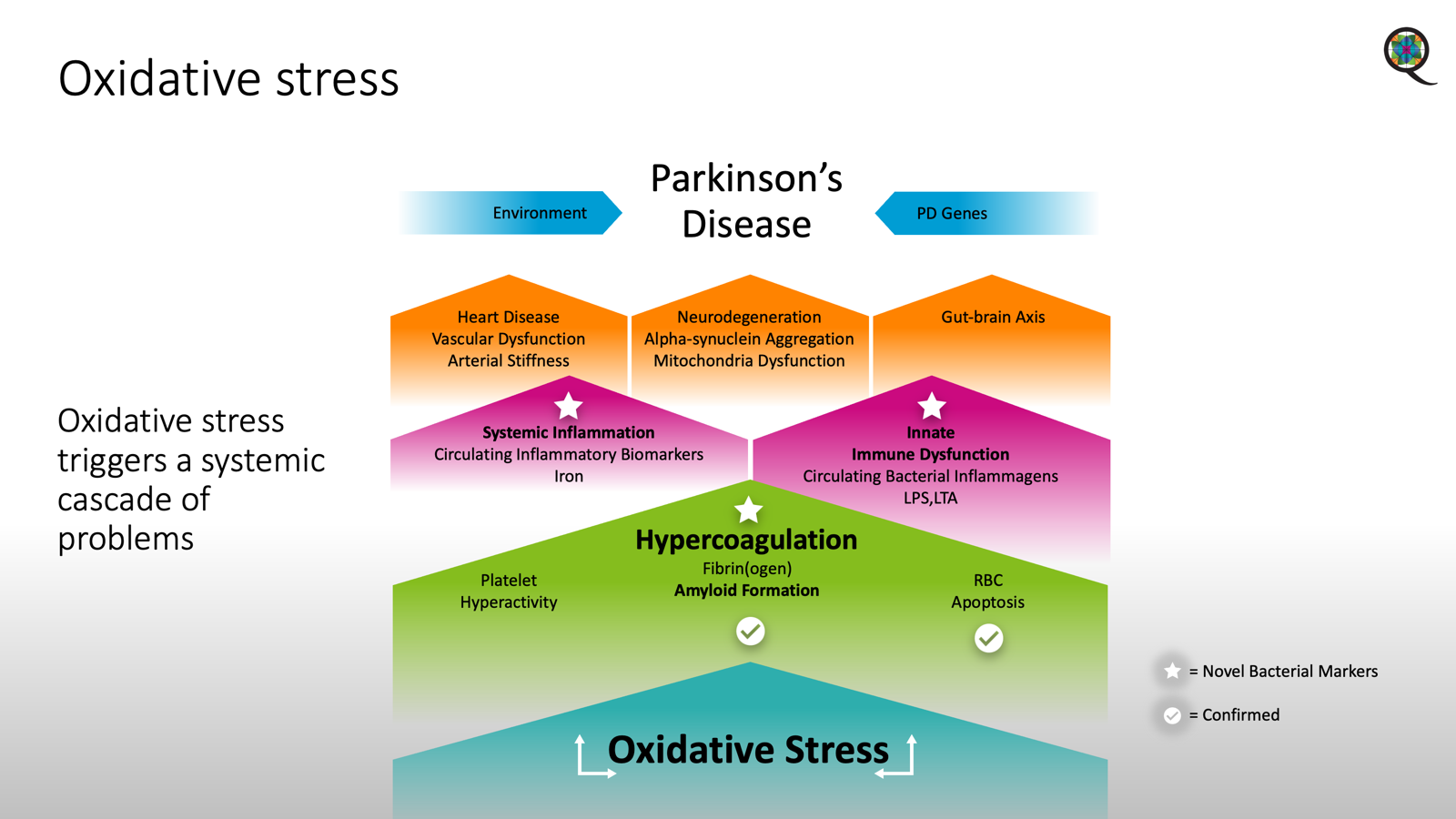
Those two branches, systemic inflammation and innate immune dysfunction, converge on a single downstream node: hypercoagulation, driven by fibrinogen and amyloid formation, platelet hyperactivity, and red blood cell apoptosis. It’s a cascade that starts in the gut and ends, if it isn’t buffered, at a blood clot. I didn’t know, when I first sketched that diagram, how literally it would end up describing what I’d eventually find in John’s own lab work, looking in the rear-view mirror after he died from a pulmonary embolism, and five more Parkinson’s patients in his exercise center in Colorado followed suit within the year.
Looking again at John’s data
The only reason I have two decades of John’s lab work to go back through at all is that we saw a functional medicine doctor several times over the years, or ordered tests on our own, at times. Most people with Parkinson’s don’t have this record, which is Mischley’s point.
Reviewing John’s labs over the decade reveals a slow, systemic narrowing of adaptive range. In 2015, metabolic strain was evident in one-carbon pathway markers like homocysteine and B12, despite normal glucose metrics. Post-2021, the instability became more pronounced and this was prior to having Covid. Post Covid we observed iron dysregulation—ferritin levels doubling while hemoglobin remained flat—and transient antibody signatures, such as anticardiolipin, appearing during periods of acute stress. Crucially, conventional markers like D-dimer and fibrinogen remained “normal” even as the underlying buffering capacity eroded, demonstrating that standard clinical tests often fail to capture the loss of resilience until a catastrophic event occurs.
In 2015, well before Sugar Shift, a fuller picture was already forming. His homocysteine was 13.6 µmol/L, elevated, sitting in the borderline range on a panel that also showed textbook-clean glucose regulation: HbA1c of 5.3%, fasting insulin of 4 µIU/mL, a HOMA-IR of 0.9. Whatever was under strain, it wasn’t glucose metabolism. His omega-3 status was severely depleted, an Omega-3 Index of just 1.15%, well under the optimal range (2015), with both EPA and DHA far below target. His HDL sat at 48 mg/dL, just under the optimal cutoff, another entry on Mischley’s list, seven years before I’d ever hear her name, alongside an elevated ApoB and an elevated Lp(a), a largely genetic clotting and cardiovascular risk marker that doesn’t show up on a standard panel. We had done the Boston Heart panel which at the time cost about $5,000, so we never repeated it for cost reasons. It was covered by insurance. And because we were focused on Parkinson’s, we weren’t really looking at clotting risks. Years of eating seed oils, before we knew it wasn’t good to have omegas that out of ratio, contributed. Fixing that became a focus after 2015 when we tossed out the seed oils. The low ratio of Omega 3’s also made his membranes less flexible. Flexibility relates to adaptability. It can take several years to clear the mess out and that’s if you don’t eat seed oils at all.
A genetic test run the same year found a variant in MTHFR, the gene most directly responsible for folate metabolism (see my glyphosate post on this) and, downstream, for keeping homocysteine in check, and notably, no inherited clotting-factor mutations at all. Whatever risk was building, it wasn’t written into his genes as a clotting disorder. It was showing up as a metabolic constraint.
That same year, an amino acid panel added detail to the picture. Methionine sat at the very floor of its reference range. Taurine was below range entirely. Cysteine, the amino acid one step downstream of methionine in the transsulfuration pathway, was actually elevated, above range, not simply “preserved,” as I’d assumed for years. These are the sulfur amino acids — I have a textbook on them that probably dates back to this test and me trying to figure out what was going on. The glycocalyx is made of sulfated polymers…sulfur. There is also a nice longitudinal microbiome study in Parkinson’s indicating issues in the transsufuration pathway.
Cystathionine, the direct intermediate between methionine and cysteine, was running at roughly three times its upper limit. Read individually, none of these values means much. Read together, they describe a pathway under real pressure: methionine draining in, an intermediate backing up, cysteine pooling above where it should sit, and taurine, the pathway’s downstream product, left short. The same report flagged a single, specific “high need”: vitamin B12, the one nutrient most directly tied to that same one-carbon pathway. Three independent measurements, taken the same year, all pointing at the same metabolic bottleneck.
By September 2021, well into the Sugar Shift years, that picture had shifted. Vitamin D had climbed to 43 ng/mL, without supplementation. Copper, ceruloplasmin, and RBC magnesium all sat in unremarkable, healthy ranges for a standard blood test, though from my RCP training, that same data still pointed to underlying copper and iron dysregulation. On paper, the raw ingredients looked like they were improving.
Then, in the months that followed, the same window in which he had a serious COVID infection, something moved that’s easy to miss on an individual lab report and hard to miss across two of them side by side. His ferritin, 167 ng/mL in September, had roughly doubled to 342 ng/mL by the following January, one month post COVID. Ferritin isn’t only an iron-storage marker; it rises as an acute-phase signal of inflammation. Meanwhile his iron saturation actually fell over the same window, and his hemoglobin stayed essentially flat, the kind of dissociation between “storage” and “circulating” iron markers that a single snapshot wouldn’t reveal, and that only shows up as a pattern when you’re willing to look at two draws together instead of one at a time. Some of this, I know understand was due to the specific Covid protocols that we followed.
By May 2022, a more specific signal appeared, ordered by Dr. Ben Edwards, the same physician who told John, at that appointment, that he wasn’t at peace. It’s a strange thing that the doctor who named the spiritual dimension of John’s illness is also the one who ordered the panel that found its physical signature. An antiphospholipid antibody panel I’d specifically requested came back with an isolated, elevated IgM anticardiolipin antibody, the least specific of the three antibody classes, and one more often associated with a transient, reactive state than an established clotting disorder. Both IgG and IgA, the isotypes more tightly linked to genuine thrombotic risk, were normal. Alongside it, an intrinsic factor antibody, the antibody responsible for pernicious anemia, which blocks B12 absorption at exactly the interface his 2015 labs had already flagged as under strain, sat right at the top of its own reference range. Neither finding, on its own, constitutes a diagnosis. What it looks like now in hindsight was a system being tested at one of its known weak points, the hypercoagulation node at the bottom of the cascade, without yet giving way.
Homocysteine tells a similar story of drift rather than a single event: 13.6 in 2015, down to a fully normal 9.9 by 2020, several years into Sugar Shift, and consistent with a real, if partial, restoration, then back up to 13.9 by March 2023, two years post COVID and still struggling to recover. His albumin that same draw, another of Mischley’s markers, was unremarkable at 4.9 g/dL, though I believe we have a later test that I can’t find where the albumin was low.
By January 2024, the conventional numbers had mostly settled again: normal D-dimer, normal fibrinogen (the same marker that sits at the center of that hypercoagulation node), normal bile acids, an RDW of 12.3%, comfortably in range, and by then the only one of Mischley’s markers we’d tracked that still looked entirely unremarkable. Read on its own, that report looks reassuring. John died of a pulmonary embolism in September 2024, eight months later. The cascade in the diagram I’d been showing in my Parkinson’s presentation has this node at its foundation. There is another more complex piece that I won’t go into here but you can read about in our paper. It relates to something called gas nanobubbles and what can cause them to coalesce and create large air-water interfaces in the body.
I can’t draw a line from the January numbers to the event in September. What I can say is that the pattern across the whole decade doesn’t look like a system that failed all at once. It looks like a system whose margins had been narrowing for years, in fits and starts, partially restored and then eroded again, showing its strain in different subsystems at different times, one-carbon metabolism in 2015, an inflammatory signature in late 2021, an antibody signature in 2022, long before any single test would have been flagged as the problem. Our Parkinson’s paper explains the physical chemistry of what is happening and I am grateful to Dr. Ninham and Matt Battye for working on the paper with me to explain things. But when you have been labeled with something like Parkinson’s then typically the system looks at you for neurological issues, not something like cardiovascular risk.
Questions worth asking
I think I’ve described a pattern clearly enough to ask better questions about it.
Can resilience, the capacity to absorb a perturbation and return to baseline, actually be measured, rather than just observed in hindsight the way I observed it in John? Is buffering capacity a fundamental property of health in its own right, distinct from and prior to the absence of disease? Does chronic disease sometimes begin as the gradual loss of adaptive range, a narrowing that predates any individual biomarker crossing a threshold?
Can restoring ecological function, in the gut, at the level of the microbiome, in the relationships between host and microbe, restore some of that lost resilience even when the underlying disease process isn’t reversible? Or could that coupled with other interventions restore the wholeness? Are we, as a matter of medical habit, spending too much effort correcting individual biomarkers back into their reference ranges, and not enough asking what maintains the whole system’s capacity to hold its own equilibrium in the first place?
I watched a beautiful, dynamic equilibrium hold for a long time, narrow slowly, widen again for a few years, and eventually give way. I don’t think that story is only about Parkinson’s.
This resonated with me. As a physician-scientist, I think dynamic equilibrium is one of the most elegant concepts in biology as health is rarely a static state but it’s an ongoing process of adaptation. Virtually every physiological system operates through continuous balancing acts: bone is constantly remodeled, the immune system calibrates between defense and tolerance, the gut microbiome shifts in response to diet and environment, and even our brains continuously rewire through neuroplasticity. Aging itself can be viewed as a gradual loss of this adaptive capacity rather than the failure of a single organ.
I also find this idea reassuring as it shifts the focus away from perfection. Health is about preserving resilience, the ability to respond to challenges and return to balance. In many ways, that resilience is a more meaningful marker of health than any isolated measurement.
Perhaps that’s one of the most profound lessons from physiology: life isn’t sustained by rigidity, but by continuous, intelligent adaptation. Dynamic equilibrium is a beautiful way to think about living well.
Thanks again!
Enjoying the phrase “dynamic equilibrium” as it carries more truth than most wellness language. Health, in my understanding, means absorbing disturbance, reorganizing, and finding a workable return. I’m curious whether you see resilience as the capacity to return to baseline, or the capacity to establish a wiser new baseline after the system has changed.